Forgot the present? What actually saves the evening
By Philipp, founder of fabelooPublished 30 August 20266 min read
Diesen Artikel auf Deutsch lesen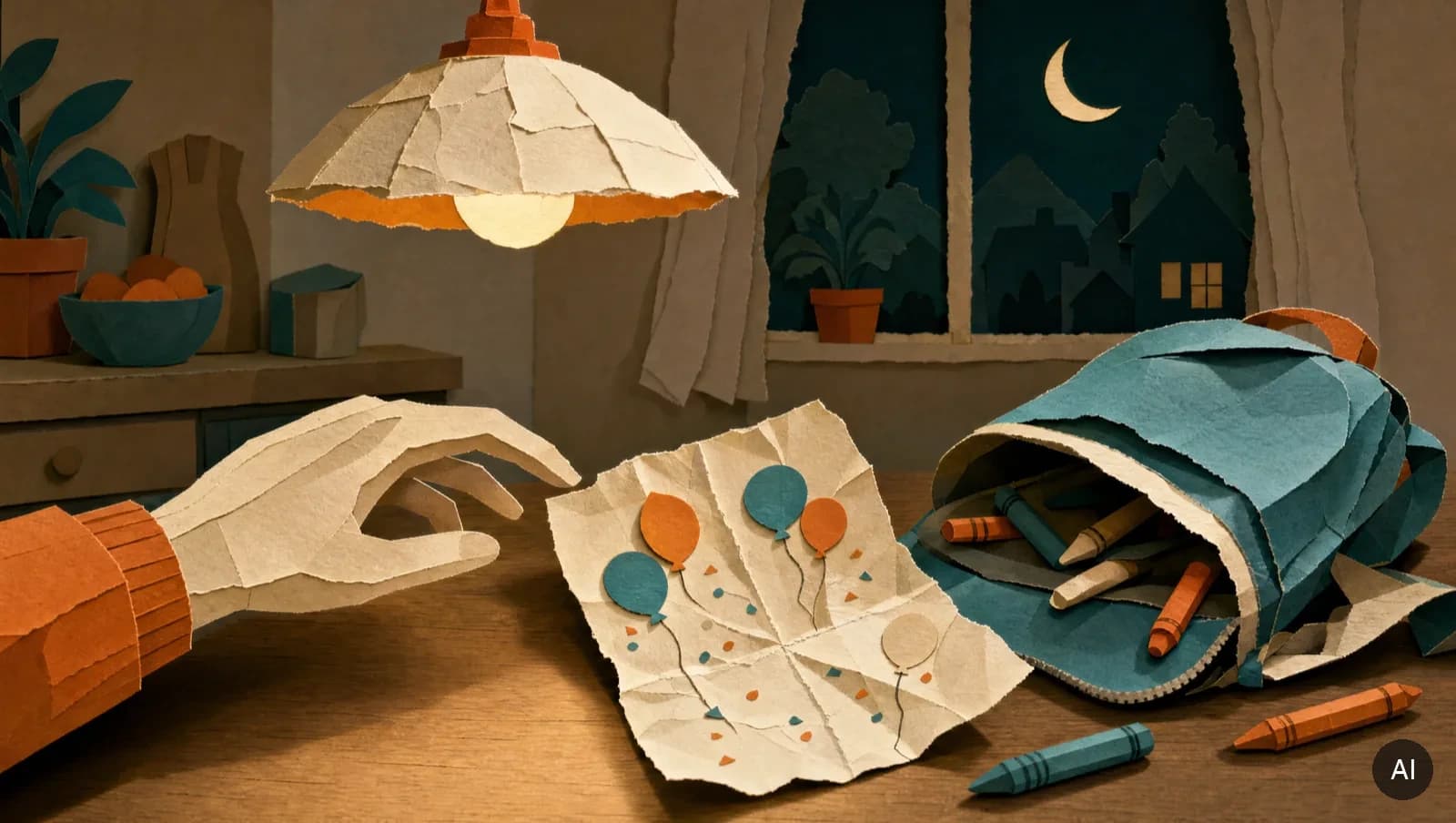
Sunday, 9.47 pm. The school bag is almost unpacked when something rustles at the bottom: a crumpled invitation, carried around for days, never handed over. "Come celebrate Linus' birthday", it says, with little balloons along the edge. Then the date. Tomorrow, 2 pm.
The shops: closed. The brain: instantly in fix-it mode. Petrol station toy aisle? That colouring set again? Anything online with overnight delivery, whatever it costs? This is exactly where a two-minute pause pays off — because gift research is remarkably clear about which of these reflexes is the wrong one.
This happens far more often than the panic suggests
Standing there without a present feels like a personal failure. The numbers disagree: almost one in five adults habitually buys gifts at the very last minute, and search engines auto-complete phrases like "forgot present sunday" — enough people have stood in this exact kitchen that the algorithm knows the scene by heart.
19%
The expensive panic buy doesn't work better — it doesn't work at all
Francis Flynn and Gabrielle Adams asked givers and receivers separately and found an uncomfortable gap: givers firmly believe price buys joy. Receivers don't. Across their studies, appreciation simply did not rise with the price tag — a finding they titled "Money can't buy love".
0
For Sunday night this means: the overnight-delivery splurge solves the adult's problem — the guilt — but not the actual task of delighting a child. What is worth the effort instead: experiences beat objects. In Cindy Chan and Cassie Mogilner's studies, experiential gifts strengthened the relationship between giver and receiver more than material ones — even when the experience wasn't shared.
In the playroom, toy number 27 was never going to win
An experiment from Toledo backs up what every parent suspects about the gift flood: toddlers played in a room with 16 toys, then with just four. With four toys, they played roughly one and a half times longer per toy — and in visibly deeper, more inventive ways. More choice produced worse play.
1.5×
So the panic buy isn't competing with "nothing". It's competing with a playroom that is already full — where the next plastic thing is, statistically, the weakest gift of all. What is genuinely scarce shows up in a different number: according to Germany's reading monitor, almost a third of children between one and eight are rarely or never read to. Things aren't scarce. Stories are — and what goes on inside a child during one is remarkable (what children do while listening).
The twist: asking is not cheating
Sometimes the best save isn't a gift but a text message. Francesca Gino and Francis Flynn showed that explicitly requested gifts are appreciated MORE than surprises — and are even rated as more thoughtful. Only givers stubbornly believe the opposite. Texting the birthday child's parents at 9.47 pm — "what does Linus actually wish for?" — isn't lazy. It aims better.
- Message the parents and ask: the most underrated option in the entire literature — wrap the answer as a handmade voucher.
- Give an experience instead of an object: cinema, pool, a farm afternoon — as a hand-drawn card.
- Give a story: read aloud, recorded, or created as an audio drama — the only thing on this list that can still be made at midnight.
For the last option, the birthday child's age matters: not every format fits every child (the right age for audio stories) — and if you're torn between a book and an audio drama, the trade-offs are here: personalised book or audio story. And if next time you have three weeks of lead time but still face a full shelf: what to give a child who already has everything — for adult milestone birthdays, the grown-up version is here: gifts for people who have everything.
The invitation lies flattened on the kitchen table. Next to it: no emergency purchase, but a note with three lines — what Linus loves, what he should get to experience, what the story might be called. By 10.20 pm the forgotten present has quietly become the most personal one in the pile. Even the balloons on the invitation look less accusing now.
Frequently asked questions
- Does a pricier gift help when time is short?
- No. Recipients don't appreciate expensive gifts more — the link exists only in givers' heads (Flynn & Adams 2009). Fit beats price.
- Is it rude to ask the parents what the child wants?
- The opposite: explicitly requested gifts are appreciated more and rated as more thoughtful (Gino & Flynn 2011). Only givers worry about it.
- What still works on a Sunday night with shops closed?
- Everything digital and everything handmade: asked-for wishes as vouchers, experience cards, recorded or created stories. A fabeloo audio drama takes a median of 33 minutes.
Sources
You might also like
3 Sept 2026·6 min read
The fortieth dragon
The same audio story for the fortieth time, and you cannot take it any more. Why children repeat, why it wears adults down — and what helps at the fridge.
Read more
1 Sept 2026·7 min read
The Finger Above the Button
Sleep aid or stimulant? What sleep research actually shows — and how to tell an evening-suitable story from a daytime one.
Read more