What children really do while they listen
By Philipp, founder of fabelooPublished 30 August 20266 min read
Diesen Artikel auf Deutsch lesen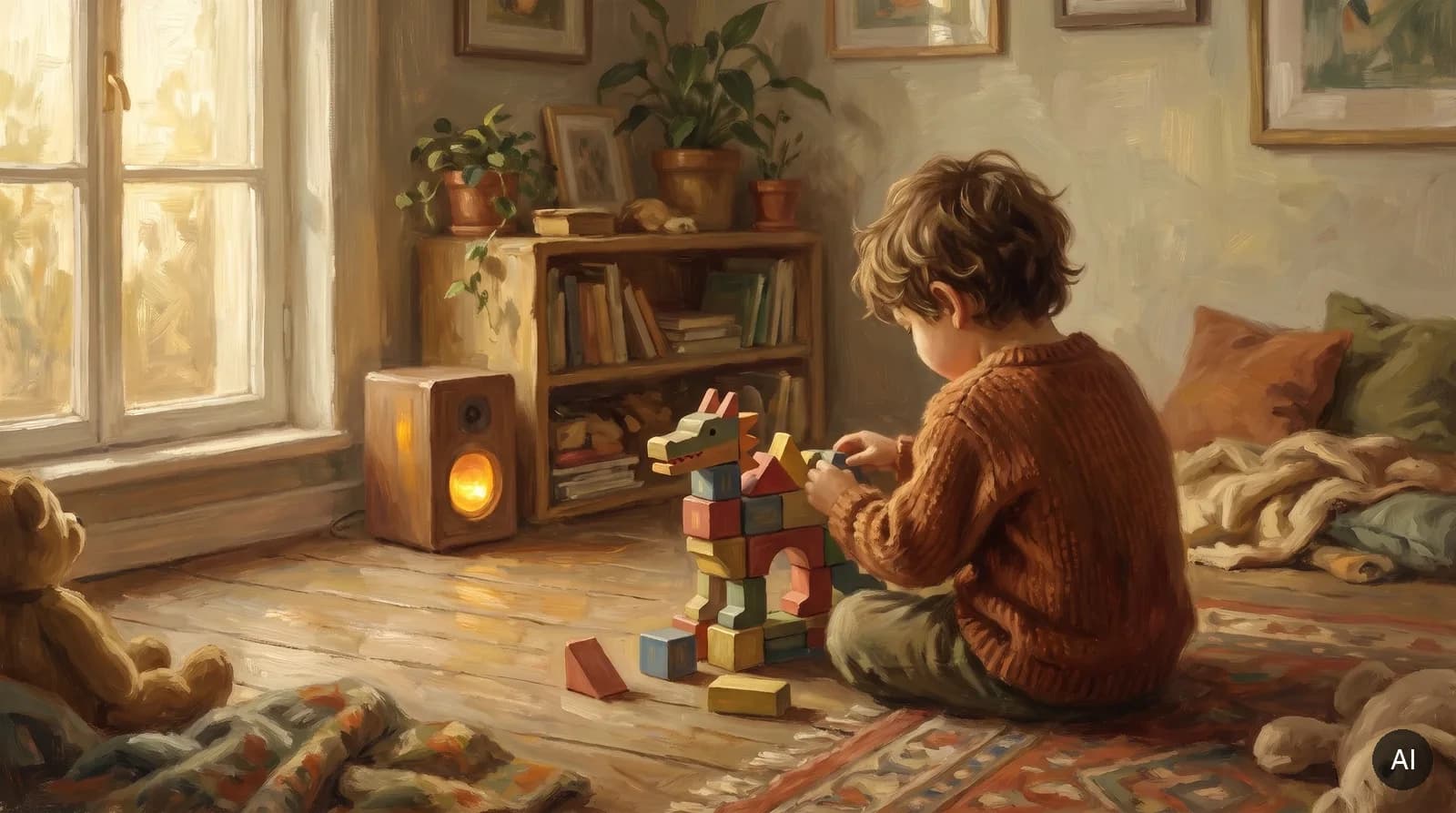
The dragon is half built. One wing done in blue bricks, the other still a heap, and the child sits with their back to the little box that has been telling a story for twenty minutes. They never look at it. They sort bricks, try one, discard it, hum a little. From the doorway, it looks like a child absorbed in something else entirely.
So you could switch the story off — nobody seems to be listening anyway. You press stop. And within one second you learn how wrong you were.
The protest is instant — and oddly precise
The child spins around before the box has even gone quiet. They don't want just any story back; they want that exact spot: the fox had just reached the cave. They can tell you what happened last. They were listening the whole time — back turned, hands full of bricks.
Which leaves the real question: what kind of listening is that? Adults know split attention as a bad bargain — type messages in a meeting and you lose both. Is it different for a child with building blocks? The answer comes from an experiment built around the most boring phone message ever recorded.
Forty adults, one dull voicemail, a pencil
Psychologist Jackie Andrade had forty adults listen to a deliberately tedious two-and-a-half minute phone message about a birthday party. Half of them were told to shade printed shapes with a pencil while listening — mindless scribbling. The other half just listened.
29%
The busy hand had not disturbed the listening. It had propped it up. Andrade's explanation: pure listening leaves spare attention, and spare attention drifts — into daydreams that consume far more capacity than any scribble. A mechanical side task soaks up exactly that surplus without competing with language.
Building is a child's way of doodling
A child sorting bricks or dragging crayons across paper while a story plays is doing what Andrade's shaders did: keeping hands and idle eyes busy so the ear can work in peace. And doing it alone is the norm, not the exception — according to the surveys cited by media researcher Sandra Niebuhr-Siebert, children mostly listen to audio on their own, while parents tend to join them for screen time instead.
The ear, meanwhile, has plenty to do. Across the production logs of the last thirty fabeloo mixes, a story carries a median of 13.6 sound events per minute — footsteps, doors, wind, music: one roughly every four seconds (own analysis, 30 August 2026). A dense story leaves the ear no room for boredom while the hands stay free. The exact opposite of a screen, which claims both.
What goes wrong with TV — and where the limit sits for audio
Before this becomes a free pass, one uncomfortable study belongs on the table. Marie Evans Schmidt and her team had fifty children aged twelve to thirty-six months play with toys for an hour; for half of it, a quiz show ran on a TV in the background. The children barely looked at it — less than once a minute, a few seconds at a time. Their play episodes still became measurably shorter and their focused attention dropped while the set was on.
No such effect has been demonstrated for audio alone, and a story does not tug at the eyes the way a screen does. But the boundary Schmidt's finding marks applies here too: a story that keeps playing after everyone has stopped listening is no longer a story — it is noise. Germany's federal health education agency puts it plainly: audio media should never become permanent background sound. The difference is the one between a child who builds while listening — and a room where something simply always plays.
Three signs the building and the listening are both happening
- The stop test: precise protest at the exact spot (“but the fox just reached the cave!”) proves listening — outrage alone doesn't count, the detail does.
- Hands stall at the tense moments: just before the reveal, the brick rests in the hand — bound attention, made visible.
- Spoken-along lines: a child reciting the favourite passage on the twentieth listen isn't half listening — they are demonstrating full ownership.
If all three are missing for days, the story is probably playing for no one — switching it off is not a loss then, just hygiene. The child will tell you. Usually louder than expected.
The dragon does get finished, somewhere between the cave and the ending. Both wings blue, the tail too short — and afterwards the child explains both things in one breath: how the story ended and why the tail has to be that way. They were in two places the whole time. That is not half an attention span. It is two whole ones.
Frequently asked questions
- From what age do audio stories make sense?
- It depends less on a birthday than on length and form — there's a full guide: Audio stories: the right age to start.
- Are headphones okay for children's ears?
- With a volume limiter (85 dB) and short sessions, yes — though for small children an open speaker is the better choice, not least so adults can listen in.
- Can a story play at bedtime?
- As a ritual with a clear end, yes — one story, then quiet. An all-night loop is exactly the permanent background sound health agencies warn about.
Sources
- Andrade, “What does doodling do?”, Applied Cognitive Psychology (Wiley)
- Schmidt et al., “The Effects of Background Television on the Toy Play Behavior of Very Young Children”, Child Development 79 (PubMed)
- ZEIT ONLINE / Sandra Niebuhr-Siebert (PDF)
- BZgA, kindergesundheit-info.de: audio media for children
You might also like
3 Sept 2026·6 min read
The fortieth dragon
The same audio story for the fortieth time, and you cannot take it any more. Why children repeat, why it wears adults down — and what helps at the fridge.
Read more
1 Sept 2026·7 min read
The Finger Above the Button
Sleep aid or stimulant? What sleep research actually shows — and how to tell an evening-suitable story from a daytime one.
Read more