The Finger Above the Button
By Philipp, founder of fabelooPublished 1 September 20267 min read
Diesen Artikel auf Deutsch lesen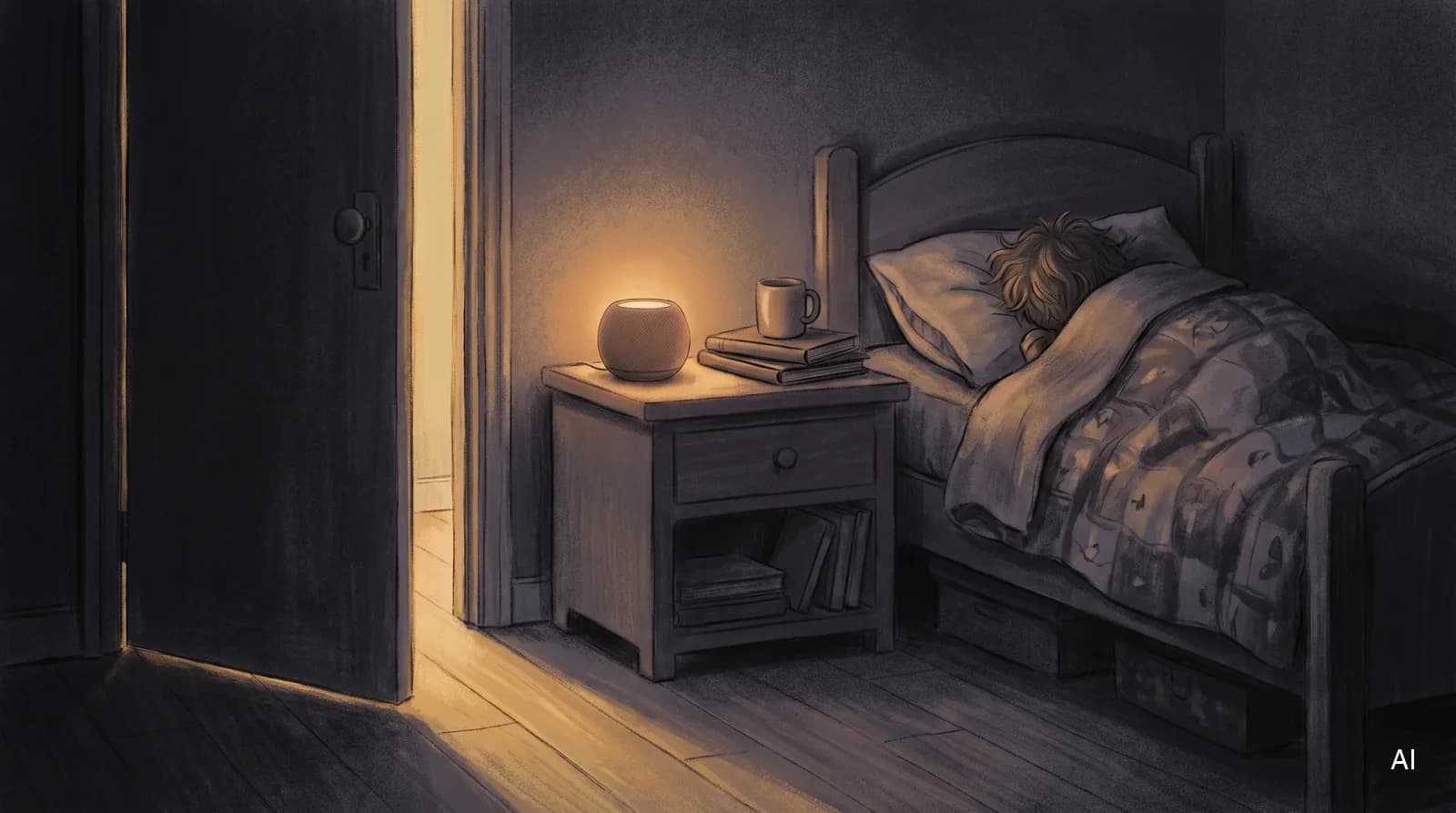
7:40 p.m. The light is off, the door open a crack. Marc is standing by the bed with his finger above the button. Below him is a five-year-old who has not been tired for forty minutes and keeps saying so. The story would settle him — that is what Marc hopes. It could also keep him awake for another half hour. He does not know, and he presses anyway.
Research gives an uncomfortably mixed answer: a language-based evening routine does lengthen sleep measurably — by less than parents hope. And whether a story settles a child or winds them up depends barely at all on the medium, and almost entirely on how the story is built.
9.6 minutes
Ten minutes sounds like little — and it is the honest figure
Nine point six minutes. Anyone hoping for a miracle number is disappointed here, and rightly so. That figure comes from one of the largest studies on the subject, adjusted for income, education and family structure, and that is precisely why it is small. Unadjusted it would have been fifteen minutes — the difference is everything that was not the routine, but the families able to keep one.
More important than the size is what the study does not separate: reading, telling, singing and talking all fall into one category. What was measured was not the book and not the speaker, but that language is in the room in the evening, and that it comes every evening. Regularity carries the effect, not the format. That is the most freeing finding for anyone too tired to read aloud — and the least comfortable one for anyone hoping a device replaces the ritual.
Why the ear counts differently than the screen
Here the evidence is clearer. Evening screen activities — television, video, games, chatting — are associated with difficulty falling asleep and disturbed sleep in a systematic review of Western studies. That finding does not carry over to audio-only material. This is not a free pass but a boundary: what is documented about screens cannot simply be transferred to listening.
The difference is not mysterious. A screen delivers light into the eye and a change of image every few seconds that keeps recapturing attention. An audio story delivers neither. The child is allowed to close their eyes without missing anything — and that is the precondition for falling asleep. Anyone who has watched a listening child slowly roll from their back onto their side has seen what that looks like.
The study everyone cites has twenty children
Search for audio stories as a sleep aid and you will eventually reach a 2022 paper: twenty families, five nights of their normal routine, five nights with audio stories, roughly fifteen minutes an evening. The sleep questionnaire improved from 2.96 to 2.32, statistically significant. It sounds conclusive.
It is worth reading as far as the paragraph press releases leave out. The authors write it themselves: the small sample does not allow the findings to be generalised, there is no control group, and because the same children were measured before and after, an expectation effect cannot be ruled out. Twenty children averaging 4.3 years old are an indication, not proof. Building an evening routine on that study means building on twenty nights.
How to recognise an evening-suitable story
If the medium barely decides — what does? The answer sits inside each story, and it has little to do with the label «bedtime story». What matters is where a story ends. One that stops in a market square at midday, with shouting and open questions, leaves a child awake no matter how gentle the voice was. One that fades out in a warm kitchen, or with a narrator quietly gathering the threads, takes the pace out with it.
The same goes for volume, and it is the one point where German-language pedagogy and English-language sleep research agree completely: devices set too loud disturb sleep and can damage hearing over time. A bedtime audio story runs quieter than you would think — quiet enough that you would have to strain to catch every word. Anyone straining is not falling asleep.
Where we get it wrong ourselves
We build personalised audio plays, and here we have to argue against our own product. An analysis of our own 94 productions shows that only 53 per cent end in a calm setting — with the narrator, in a warm interior or outdoors at night. Almost a third end in bright daylight outdoors, the most wide-awake ending there is. As an afternoon adventure that is right. As a sleep aid it is not.
The second objection comes from pedagogy: sending a child to sleep with the same story every evening couples falling asleep to a device. When the device is missing — in a holiday flat, at a grandmother's house — what is absent is not the story but the condition. Specialists therefore recommend listening to audio stories deliberately while awake as well, in the afternoon, sitting up. Not because something bad happens in the evening, but so that listening does not shrink to a single function.
Marc pressed the button. The five-year-old asked two more questions, then stopped. What made him sleepy was probably not the story itself — but that it starts at the same time every evening, that the door stays open a crack, and that someone stands beside him for a moment. The story is the occasion. The ritual is the effect.
Frequently asked questions
- How loud should a bedtime audio story be?
- Quiet enough that the voice is just intelligible without requiring concentration. Devices set too loud disturb sleep and can damage hearing with daily use — the one point where pedagogy and sleep research agree.
- Headphones or a speaker in the room?
- For the evening, a speaker at low volume has much in its favour: headphones invite higher levels, press uncomfortably when sleeping on one side, and can tangle during the night. For awake listening in the afternoon they are unproblematic.
- Should the story stop automatically?
- An ending beats an endless loop. If sound runs all night, the child misses the quiet phases in which sleep deepens. A track with a clear ending, or a sleep timer, solves it.
- From what age does this make sense?
- The large routine study measures children from three years old, the smaller audio study children between three and eight. For children under two there is no reliable data — there, a parent's voice remains the first choice.
- What if the child no longer falls asleep without it?
- Then the coupling already exists. Specialists recommend shifting listening gradually into the waking afternoon and carrying the evening with other constant signals — the same time, the same order, the same door open a crack.
Sources
- Hale, Berger, LeBourgeois & Brooks-Gunn (2011): Bedtime Routines, Sleep Duration and Wellbeing, «Journal of Family Psychology» 25(3)
- Chung et al. (2022): Out Like a Light — Audio-Based Sleep Aide, «IJERPH»
- Systematic review: Electronic media use and sleep in children, «BMC Public Health» (2021)
- Leben & erziehen: Can audio stories harm children's sleep? (German)
You might also like
3 Sept 2026·6 min read
The fortieth dragon
The same audio story for the fortieth time, and you cannot take it any more. Why children repeat, why it wears adults down — and what helps at the fridge.
Read more
31 Aug 2026·6 min read
What do you give a child who already has everything?
The shelf is full, the wish list is empty. Why more toys measurably weaken play — and which gifts are still in use three weeks after the party.
Read more