The fortieth dragon
By Philipp, founder of fabelooPublished 3 September 20266 min read
Diesen Artikel auf Deutsch lesen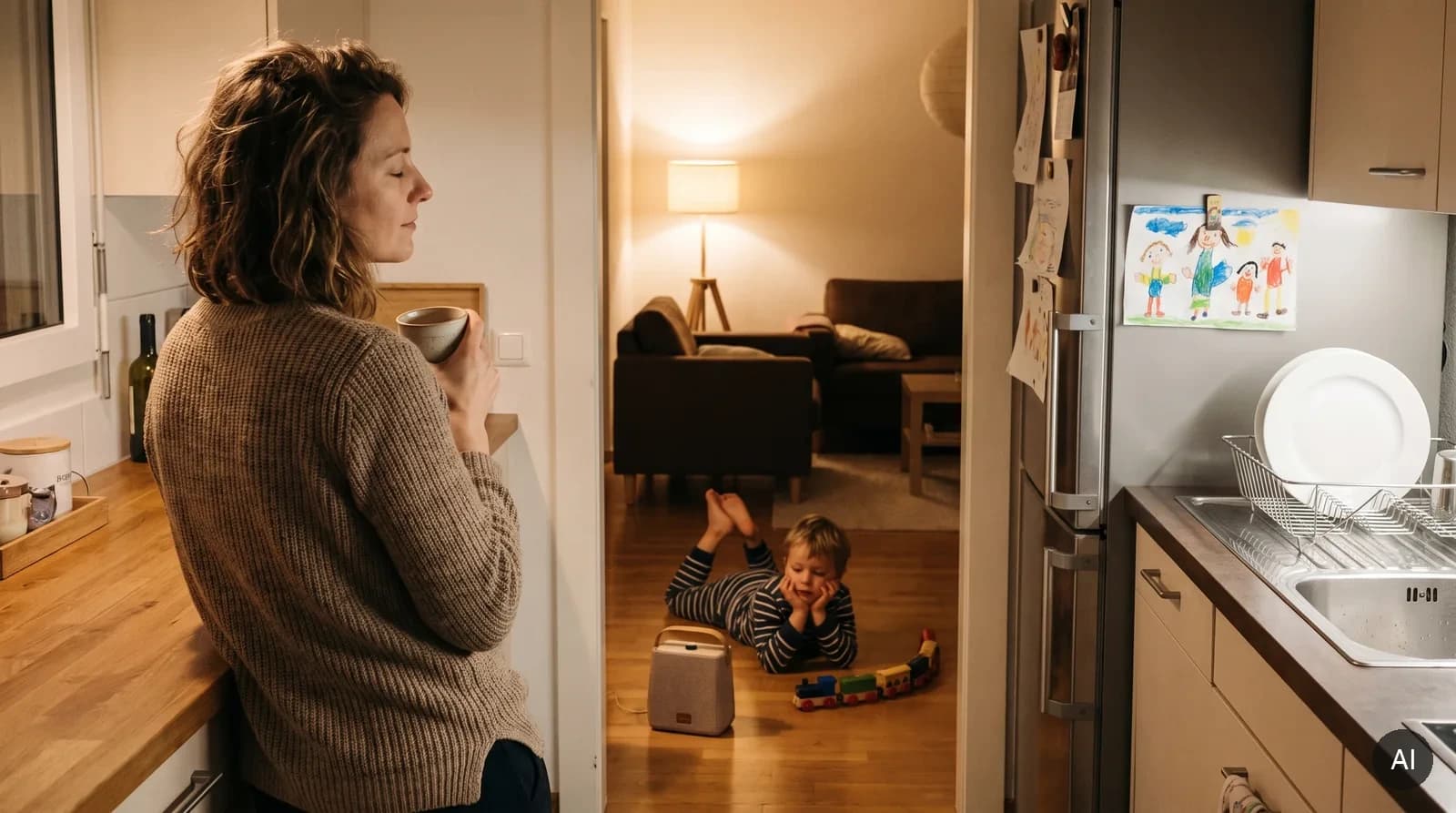
Tuesday, just after seven. The mother leans against the fridge with a half-dried pan in her hand and closes her eyes. From the next room comes Bertram, the dragon who cannot fly — for the fortieth time. She knows every pause. When the line about the cloud comes, her lips move along without her noticing.
What she cannot see from the fridge: the child on the floor is not hearing the story she hears. Today, for the first time, it hears the dragon take a breath before the jump. Forty rounds for the child, four too many for the mother — and the gap between them is not patience. It is a different way of listening.
What a child hears the tenth time
An adult hears a story as a plot: beginning, problem, solution. Once known, it is done. A child hears it as a room to move around in. The first time, the plot; the third time, the voices; the tenth time, the pause before the jump. The room stays the same, the child stands somewhere new each time.
That this is measurable, not merely a kind reading, was shown by psychologist Jessica Horst at the University of Sussex. Sixteen three-year-olds were read picture books with made-up words over one week — half of them heard the same stories three times, the other half heard different stories each time, with the same number of new words.
150%
The authors put it plainly: children in the same-stories condition «performed 150% better on the retention trials». For the child, repetition is work that pays. The second time round it no longer has to hold the plot together, so its head is free for the word it missed the first time. For the mother at the fridge it is the same work, unpaid. Or is it something else?
Why adults cannot stand it
The difference is not patience. The adult finished building the story on the first listen, and a finished building holds no riddles. What remains is the sound without the question — which is precisely what an earworm is. The tune does not leave because it has nothing left to do.
In a ZEIT ONLINE piece, linguist Sandra Niebuhr-Siebert describes the loop as a way of learning: children listen to the same audio play up to a hundred times, each time with a different question in mind. In the same piece, the author admits she sometimes wants to scream when the same character gets out of bed once more. Both are true, and both happen in the same room.
So the mother does not have fewer nerves than the child. She has less left to find in the story. Unless the story holds more than an adult picks up the first time.
Thirteen sounds a minute
An audio story is not only plot. Underneath the words lies a second layer that hardly anyone notices consciously the first time: footsteps on gravel, a door that does not quite close, wind turning before a storm, a spoon in a glass. In fabeloo's production database, measured on 3 September across 59 finished audio stories, the median is thirteen such sound events per minute, plus three different voices per story.
Over ten minutes that is more than a hundred small events sitting beneath the plot on the first listen. The child picks them up one by one — which is why the fortieth round is not the fortieth for the child. It is the first one with the breath before the jump. Except that the loop has a downside, and it has little to do with the child.
The uncomfortable side of the loop
According to the miniKIM study of 2020, 54 percent of two- to five-year-olds listen to audio stories alone, with no adult in the room. The loop is also what runs when nobody has time: it keeps the child calm and it keeps the child busy. The child really is practising — but it practises alone, and nobody hears what it found on the fortieth round.
What helps the mother at the fridge is therefore not the off switch. It is one single round in which she lies down next to the child and hears the breath before the jump herself. After that the story is a different one for her, because she can hear the child inside it. And the loop ends when the child is finished with it — almost always overnight, without warning.
| Round | What the child hears | What the adult hears |
|---|---|---|
| 1st | the plot, with effort | the plot, done |
| 3rd | the voices, who likes whom | the same plot |
| 10th | the pause before the jump, the wind | an earworm |
| 40th | the breath the dragon takes | the pan in her hand |
On Thursday the child wants a different story, one with a fox. The mother stands at the fridge, the pan long dry, and when the line about the cloud would come, her lips move along once more. It is the line nobody says any more.
Frequently asked questions
- When does the loop become too much?
- When the child no longer listens but only wants the sound in the background — then the story runs like a radio. A quick question shows it: a child who can tell you what happens next is still listening.
- Should I suggest a new story?
- Alongside, not instead. A second story on the shelf takes nothing from the first; the child switches by itself once the first has nothing new left to give.
- Does it help to turn the volume down?
- For the parents' nerves, yes; for the child, no. The quiet sounds under the words are exactly what it discovers on the tenth round. One room of distance beats a volume knob.
Sources
- Jessica S. Horst, Kelly L. Parsons, Natasha M. Bryan: «Get the Story Straight: Contextual Repetition Promotes Word Learning from Storybooks», Frontiers in Psychology 2011
- Ines Schipperges, ZEIT ONLINE: «Und im Hintergrund dudelt Paw Patrol» (26 June 2024, with Sandra Niebuhr-Siebert; PDF hosted by Humanistische Hochschule Berlin)
- miniKIM study 2020, Medienpädagogischer Forschungsverbund Südwest
You might also like
1 Sept 2026·7 min read
The Finger Above the Button
Sleep aid or stimulant? What sleep research actually shows — and how to tell an evening-suitable story from a daytime one.
Read more
31 Aug 2026·6 min read
What do you give a child who already has everything?
The shelf is full, the wish list is empty. Why more toys measurably weaken play — and which gifts are still in use three weeks after the party.
Read more