Audio stories: the right age to start
By Philipp, founder of fabelooPublished 30 August 20266 min read
Diesen Artikel auf Deutsch lesen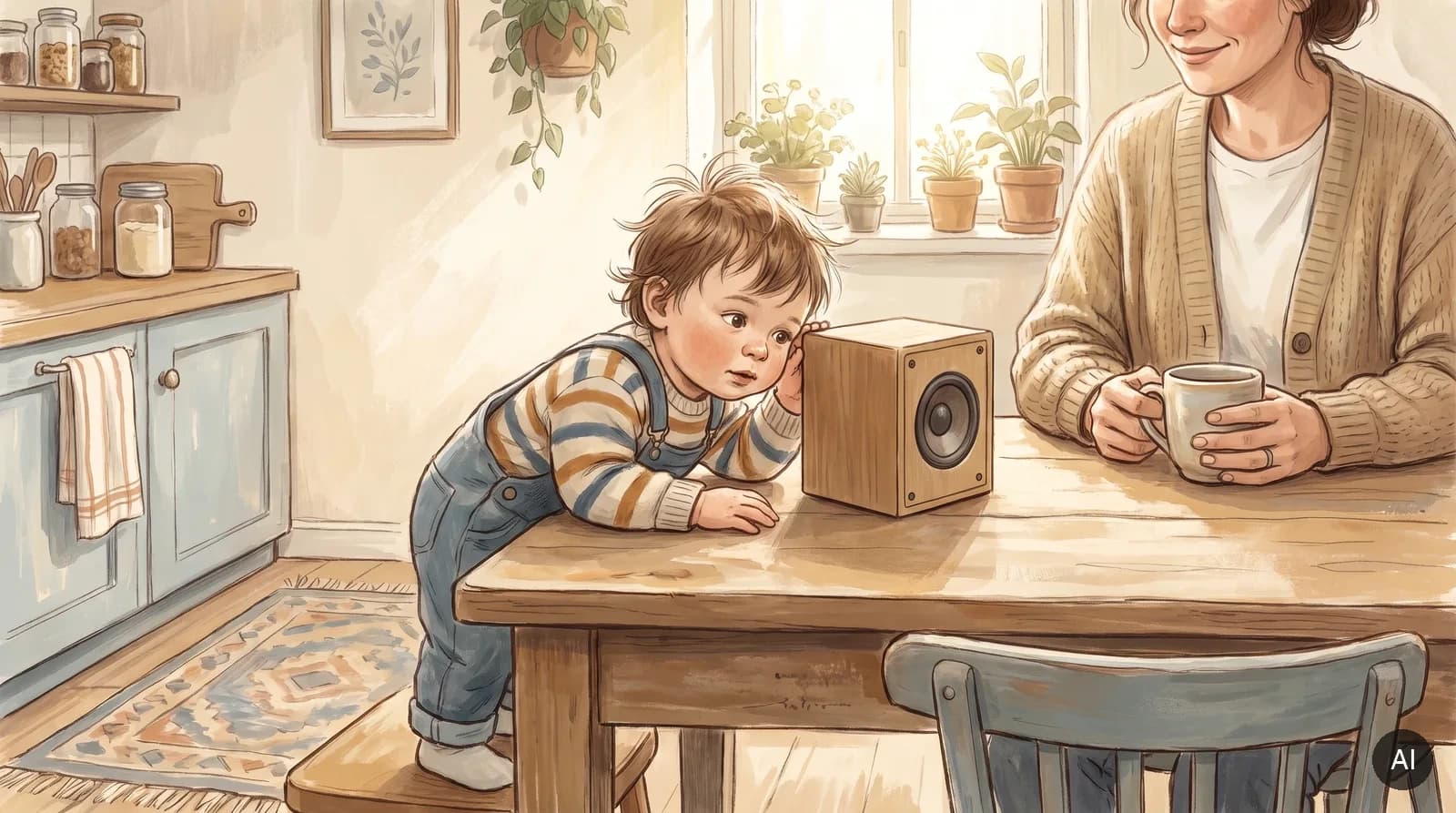
The experiment lasts ninety seconds. The two-year-old asked for the story her big brother listens to — she sits still, listens, frowns. Then she pushes the box across the table, announces “done”, and demands the beetle song. For the fourth time today. It isn't defiance. It is a rather precise self-diagnosis.
The rejected story's box says “age 3+”. But what does that mean — and how do you tell whether your child is there, given that children rarely keep to their birthdays on schedule?
The starting line is earlier than most parents think
SCHAU HIN!, the media-guidance initiative backed by Germany's federal family ministry, places the entry point surprisingly early: from the second year of life, audio can already be enriching. What they mean, though, is not the big brother's detective story — it is exactly what the two-year-old is doing at the table: songs, rhymes, sound verses, a few minutes long, repeated a hundred times.
And that early start has long become normal. What stands out: listening is growing fastest in precisely the age group with the least guidance.
35%
A story without pictures is heavy lifting
Why does the two-year-old bail after ninety seconds? Because a told story demands more than a song. The child has to hold characters in mind that they have never seen, map a beginning onto a middle and an end, and build images out of nothing but words. Those abilities typically mature around the third birthday — alongside pretend play and the first attempts at telling stories of their own.
That the effort pays off is shown in the research of Sandra Niebuhr-Siebert, professor at the Humanistische Hochschule Berlin: in a study with her colleague Ute Ritterfeld, audio stories supported language development in three-to-four-year-olds. The reason sits in the medium itself — where no picture helps, language has to build space, time and characters on its own, closer to a book than to a film.
What works at which age — a rough staircase
From the SCHAU HIN! and federal health agency guidance plus developmental milestones, a rough staircase emerges — orientation, not a checklist. Every child takes the steps at their own pace:
| Age | What carries | Typical length |
|---|---|---|
| ~1–2 | songs, rhymes, sound verses — repetition is the content | a few minutes |
| ~3+ | simple everyday stories, one thread, a clear ending | 5–10 minutes |
| ~5+ | first story arcs, several characters, gentle riddles | 10–15 minutes |
| ~7+ | longer episodes, series, detective and adventure material | 15 minutes and up |
Germany's federal health education agency (BZgA) adds a ceiling to the staircase: for three- to six-year-olds it recommends at most 45 minutes of audio media a day, up to about 60 by age ten — and explicitly no permanent background sound, where the box turns into room furniture.
Listening is the first medium children use on their own
There is a reason for this staircase that rarely gets thought through. With television, someone is usually sitting alongside — explaining, skipping, switching off. With audio, nobody is. And that changes what an appropriate length even means:
41%
So a length does not have to suit a read-aloud situation. It has to suit a child alone in a room. Nobody there notices that attention went at minute six — the story keeps running, the child plays on beside it. Observation beats the label anyway. Which puts the real question on the table.
“From what age” is the wrong question
There is no hard lower limit below which listening would be off-limits — and trying too early does no harm. It simply ends: after ninety seconds, with a pushed-away box. Children opt out of content that doesn't carry them. What matters is not the number on the box but the format: short enough to be heard whole, repeatable, free of fear spikes — and, at the start, with an adult in earshot who notices what lands.
Turned around, it becomes obvious: a four-year-old with a forty-minute crime story is worse cast than a two-year-old with a three-minute song. The age was never the risk. The length is.
The two-year-old gets her beetle song, fourth time today, and sings along with the last line. A year from now she will demand her brother's story again — and this time she will stay until the fox is back out of the cave. She will pick the moment herself. All you have to do is keep the box within reach and wait until “done” stops arriving at second ninety.
Frequently asked questions
- From what age are headphones suitable?
- From kindergarten age at the earliest, with a volume limiter at 85 dB and short sessions — before that, an open speaker is the better choice.
- From what age can stories be slightly scary?
- As a rule of thumb from school age, and only with a reassuring resolution — what counts is how the child falls asleep afterwards, not the label.
- Do foreign-language stories make sense for small children?
- As a language bath yes, as stories hardly: what a child doesn't understand carries no story arc. Songs work in a foreign language much earlier than told stories do.
- What do children actually do while listening?
- Usually something with their hands — and that is a good sign: What children really do while they listen.
Sources
You might also like
3 Sept 2026·6 min read
The fortieth dragon
The same audio story for the fortieth time, and you cannot take it any more. Why children repeat, why it wears adults down — and what helps at the fridge.
Read more
1 Sept 2026·7 min read
The Finger Above the Button
Sleep aid or stimulant? What sleep research actually shows — and how to tell an evening-suitable story from a daytime one.
Read more