What do you give a child who already has everything?
By Philipp, founder of fabelooPublished 31 August 20266 min read
Diesen Artikel auf Deutsch lesen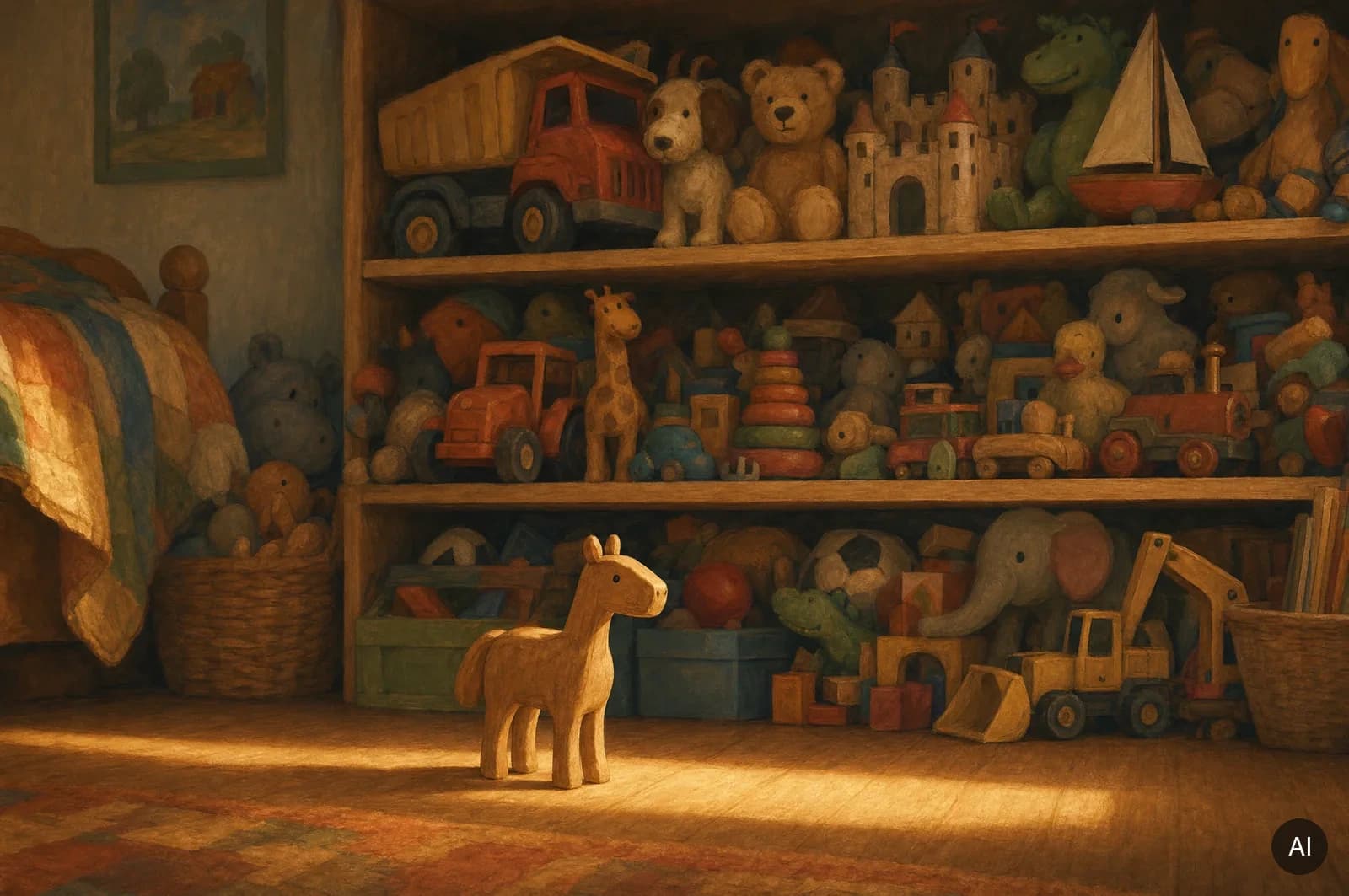
Franziska is a godmother, and she is early: three weeks before her godson's birthday she stands in his room looking for a gap on the shelf. There is none. Three construction trucks, two knight's castles, a basket of plush, last year's remote-control car — batteries still in, tyres like new. Asked what he wishes for, the boy says the sentence that gets more expensive every year: "Don't know."
What do you give a child who already has everything? The obvious answer — something bigger, something newer — is exactly what filled the shelf in the first place. The less obvious one starts with a number from the toy industry and ends with a research finding that sounds wrong the first time you read it.
The pile grows by design
€168
A birthday party bundles that sum into one afternoon: after the guests leave, ten or twelve new things stand in the room. Visit three days later and you will almost always see the same picture — one of them is being played with. The rest has already become scenery. For a long time that looked like ingratitude. Until someone measured what quantity itself does to play.
Fewer toys, play twice as deep
A team around Carly Dauch and Alexia Metz at the University of Toledo let toddlers play freely twice: once with sixteen toys in the room, once with four. With only four, children played with each single toy about twice as long — and in noticeably more ways. Abundance itself was the disruption: every additional toy is an invitation to switch before handling can turn into depth.
4 vs 16
For the gift question this flips the logic: whoever adds one more thing to a full shelf dilutes all the others with it. The best present for a child who has everything does not make the shelf fuller — it makes something else fuller. But what?
What actually connects giver and child
Cindy Chan and Cassie Mogilner compared material and experiential gifts across a series of experiments — concert tickets versus boxed goods, shared versus wrapped. Their result, published in the Journal of Consumer Research: experiential gifts strengthened the relationship between giver and recipient more than material ones — whether or not the experience was shared. The reason: an experience creates emotion when it happens, not only when it is unwrapped. And emotion is what relationships grow on.
Translated to children this does not mean "zoo instead of stuff". It means: a gift keeps working when it creates something that continues after the wrapping paper — an appointment, a skill, a story the child appears in. Five questions help before buying:
- Will it still be in use in three weeks — or scenery in three days?
- Does it create something shared (a date, a ritual, a conversation) or just ownership?
- Can the child appear in it — with their name, their world, their courage?
- Does it grow (a skill, a collection, a sequel) or is it finished after one use?
- Would the child miss it — or only notice something is gone if you asked?
The honest limit: unwrapping still counts
As clear as the findings are, the experience argument likes to skip one thing: for a child, the wrapping-paper moment is not a side note but the summit. An envelope holding a zoo date four weeks away is, to a five-year-old, first of all: an envelope. Meaningful giving builds both — something to hold now and something that keeps running afterwards. The combination beats either part alone.
That is where the gifts live that survive the party: the cooking set plus the cooking night together. The swim goggles plus the swim course. The plush tiger plus the story in which it goes on an adventure with the child. If you are reading this the night before the party, the emergency version of this list is here: forgot the present — what saves the evening. And why a child would rather hear one beloved story a hundred times than want a hundred new ones: the same story, for the hundredth time.
In the end Franziska added nothing to the shelf. On the birthday table lay a small parcel — swim goggles — and a card: "Saturday, you and me, the pool. And in the evening you'll hear how you, the diver, find the treasure." The remote-control car was still standing there long after the boy was in the water.
Frequently asked questions
- How many presents make sense at a child's birthday party?
- There is no robust study number. The Toledo findings argue for few but fitting things; rules of thumb like the four-gift rule are convention, not research.
- Should old toys be sorted out before new ones arrive?
- With the child, not secretly: choose together what gets donated or stored. Rotation — boxes in the basement, swapped every few weeks — keeps toys interesting without throwing anything away.
- What if grandparents insist on giving big?
- Offer a frame instead of a ban: one joint bigger gift instead of five separate ones, or time as a present — an outing, a course, a subscription. The wish behind it is closeness, not volume.
Sources
- Dauch, Imwalle, Ocasio & Metz: «The influence of the number of toys in the environment on toddlers' play», Infant Behavior and Development 50, 2018
- Cindy Chan, Cassie Mogilner: «Experiential Gifts Foster Stronger Social Relationships», Journal of Consumer Research 43(6), 2017
- das spielzeug: German toy market figures 2025
You might also like
3 Sept 2026·6 min read
The fortieth dragon
The same audio story for the fortieth time, and you cannot take it any more. Why children repeat, why it wears adults down — and what helps at the fridge.
Read more
1 Sept 2026·7 min read
The Finger Above the Button
Sleep aid or stimulant? What sleep research actually shows — and how to tell an evening-suitable story from a daytime one.
Read more