Milestone birthdays: gifts for people who have everything
By Philipp, founder of fabelooPublished 31 August 20266 min read
Diesen Artikel auf Deutsch lesen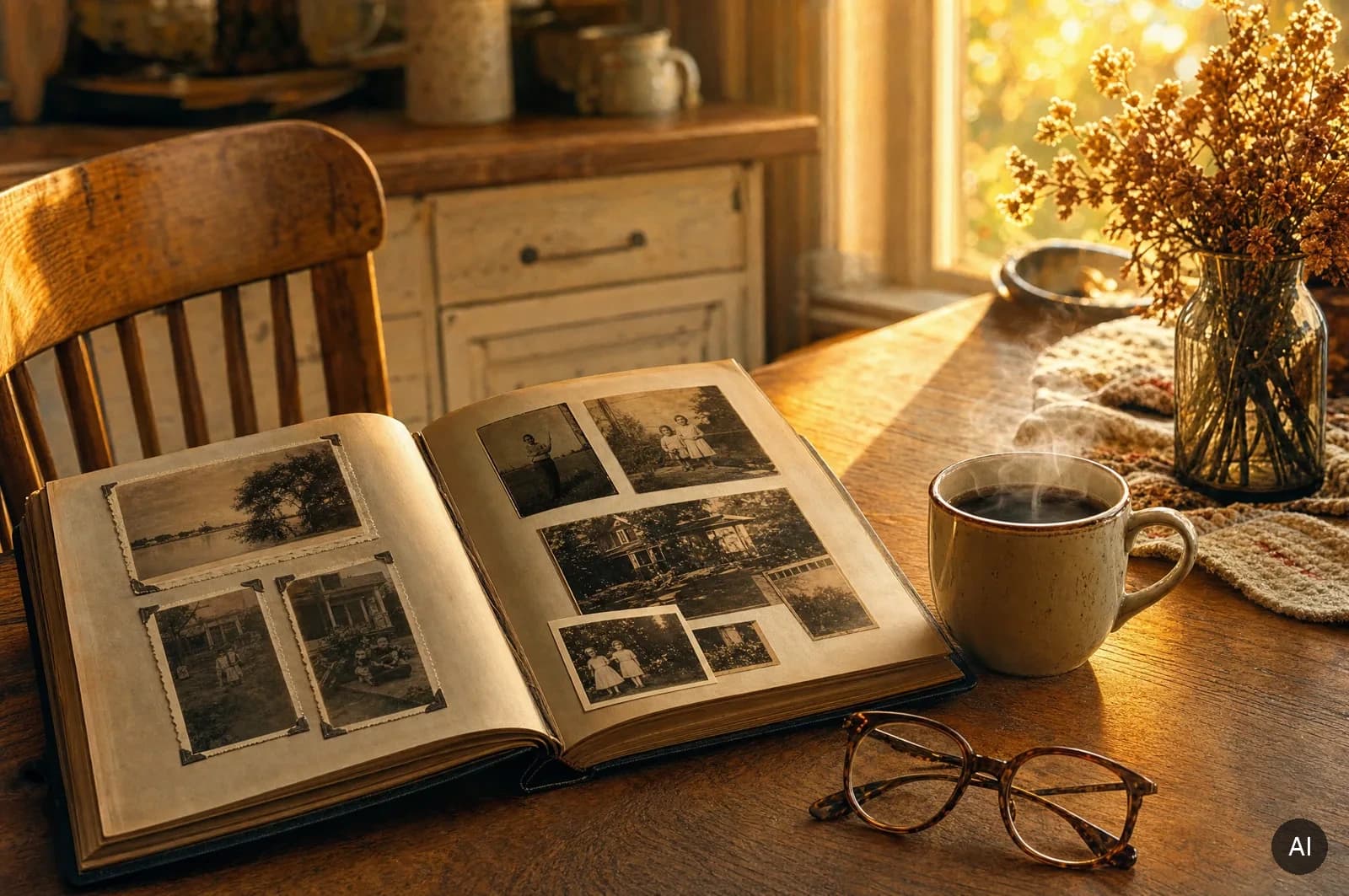
The family chat is called "Mum 70 🎉" and it is the quietest place in the family. Corinne opened it three days ago: "Ideas?" Since then: her brother with one thumbs-up. Her sister-in-law with "voucher?". And below that, the answer Mum herself gave on the phone, word for word the same as before her sixtieth: "Don't give me anything, I already have everything."
That sentence is not deflection — it is an accurate description. By seventy, the house holds vases, scarves and coffee machines for half a lifetime. What is missing sits on no shelf — and that is exactly where a line of research begins that has been asking since the 1960s what remembering does to people.
Remembering is not retreat — it works, measurably
When psychiatrist Robert Butler described the "life review" in 1963, dwelling on old stories still counted as decline. Today the evidence points the other way: structured remembering — sorting photos, telling life chapters, passing stories on — is among the best-studied ways to strengthen wellbeing in older adults.
d = 0.54
For the gift question this means: the most effective raw material for a person who has everything is already in the house. It is their own stories. The surprising twist in the research, though, is WHO ELSE such a gift benefits — and that part is about the grandchildren.
The gift to grandma works on the grandchildren
Psychologists Marshall Duke and Robyn Fivush of Emory University asked children twenty questions about their own family history: Do you know where your grandparents grew up? How your parents met? The result of their "Do You Know" scale became famous: children who knew more about their families showed higher self-esteem, less anxiety — and proved more resilient under stress, in data collected around September 11, 2001.
20 questions
A memory gift for a milestone birthday is therefore addressed twice: it hands the guest of honour their own story back — and it makes that story reachable for the next generation at all. The vase goes in the cupboard. The story of grandad crossing the border on his moped in 1962 keeps working inside the grandchildren.
Three ways to give — and what each leaves behind
| Type of gift | Example | What remains after the party |
|---|---|---|
| Object | Vase, scarf, machine | Ownership — often ballast for someone who has it all |
| Experience | Concert, trip, dinner | A shared day and the memory of it |
| Memory | Photo book, oral-history interview, a told life story | Identity for the celebrant, roots for children and grandchildren |
The three forms do not exclude each other — the strongest milestone gifts combine rows two and three: a celebration AND something that makes the life story graspable. How ambitious it gets depends only on the time left before the party — from an evening-length interview series to a story built from a handful of notes.
Where memory gifts go wrong
To be honest: not every memory is golden. Reminiscence research itself stresses that what counts is not the event but the meaning a person gives it today — the same childhood can be home or wound. So ask quietly beforehand: which chapters are for celebrating, which stay closed? A memory gift is a gift, not an interrogation — the celebrant keeps directing their own story.
If your recipient is a child rather than a milestone adult, the same mechanics apply one size smaller: what to give a child who already has everything. And if the party is tomorrow and nothing is ready: what actually saves the evening.
In the "Mum 70 🎉" chat, on the evening of day three, a message pings. Corinne types: "I have an idea. Everyone sends me their favourite Mum story by Sunday. I'll handle the rest." Her brother does not send a thumbs-up. He writes: "The one with the rowing boat. I'll tell you on the phone, it's too good to type."
Frequently asked questions
- What to give for a 70th birthday when travelling is no longer easy?
- Bring the experience home: the celebration dinner at their place instead of a restaurant, the concert as a house concert, the trip as a told memory of earlier trips.
- How early should a memory gift be started?
- Interview-based forms (oral history, photo books with texts) need several weeks. Told or audio-produced stories built from a few notes also work on short notice.
- Does this apply to 30th or 40th birthdays too?
- The mechanics yes, the register no: younger milestones carry better with humour and present tense (the flat-share years, the first boss) than with the grand life review — at 40 that can accidentally sound like a final balance sheet.
Sources
- Bohlmeijer, Roemer, Cuijpers & Smit: «The effects of reminiscence on psychological well-being in older adults: A meta-analysis»
- Westerhof et al.: «In search of the best evidence for life review therapy», Clinical Psychology: Science and Practice, 2019
- Duke, Lazarus & Fivush: «The power of family history in adolescent identity» («Do You Know» scale), Emory University
You might also like
3 Sept 2026·6 min read
The fortieth dragon
The same audio story for the fortieth time, and you cannot take it any more. Why children repeat, why it wears adults down — and what helps at the fridge.
Read more
1 Sept 2026·7 min read
The Finger Above the Button
Sleep aid or stimulant? What sleep research actually shows — and how to tell an evening-suitable story from a daytime one.
Read more