Why children listen to the same story a hundred times
By Philipp, founder of fabelooPublished 25 August 20267 min read
Diesen Artikel auf Deutsch lesen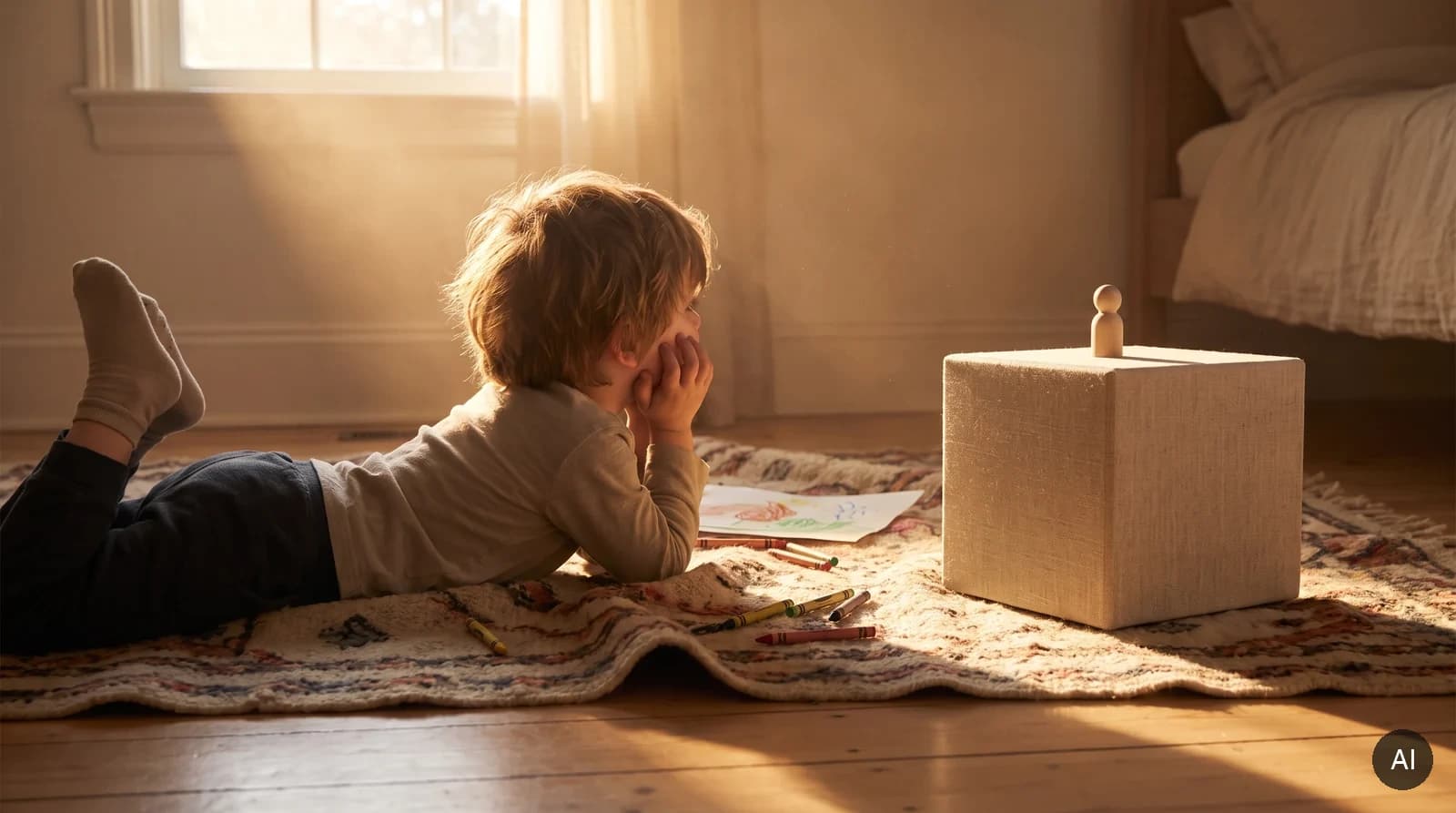
You notice it at a traffic light. The track has looped again, and you are mouthing the line before it arrives — the one where the badger finds the door, always on the same syllable. In the back seat nobody is surprised. That is rather the point.
And then comes the thought you would not put in a parenting forum: can this still be good for them? Not for your own nerves, which are a separate matter. For the child.
It is not a niche habit
Among two- to five-year-olds, roughly 35 per cent now listen to audio stories daily or almost daily. Six years earlier it was 17. The figure doubled in under half a decade, in exactly the age group where parents carry the most guilt.
35 %
What is striking is how quietly it happened. Screens get negotiated in minutes and rules. Listening gets negotiated hardly at all — it feels more harmless. Whether it is, few people asked.
The obvious explanation is the wrong one
The easy reading of the loop is laziness: the child takes what it knows because new things are work. Some go further and suspect something addictive — the same reward, pulled again and again, like a slot machine.
Sandra Niebuhr-Siebert, professor of education at the Humanistische Hochschule Berlin, researches how media shape children's development. She knows the loop from her own work — and does not consider it a habit to be broken. She considers it one of the medium's chief advantages.
What a child gains by learning nothing new
Up to a hundred times, she says, children will replay one and the same story. «It means they memorise the content – and that does them good.» The sentence that follows is the one worth keeping:
Which turns the thing around. The child is not on its fortieth listen because a new story is too much effort. It is there because this is a place — perhaps the only one — where it knows everything. In a day full of events it cannot yet file, a story whose ending is fixed is not a step backwards. It is somewhere the child gets to be the grown-up.
The predictable relieves and calms, she says, which matters in a life where so much is new. Anyone who has watched a child mouth a familiar line sees it at once: they are not listening. They are performing.
One channel, and what that does to the pictures
Every medium has its own potential, Niebuhr-Siebert says. Audio's lies in occupying one channel only. «It helps us let quite different images form through our imagination than when the visual is supplied for us.»
There is a linguistic side effect that is less obvious. With pictures in front of you, she notes, it is enough to say: «Look over there, in the left corner.» Audio has to describe precisely where you are and what is there. «That means space and time get put into context much as they do in written text.» Even the grammar — the use of the past tense — tends to follow written language.
An audio drama therefore sits closer to a book than to a film, though to a parent it feels like television without the picture. In a study with her colleague Ute Ritterfeld, Niebuhr-Siebert found that audio stories can support language development in three- and four-year-olds.
How to spot a good one without being an educator
She names a marker concrete enough to check on the next listen: a good audio story uses unfamiliar words and explains them. Her example: a «green scarab» turns up, is explained as a dung beetle, and the word then keeps returning until it sticks. Listen for it and you hear the difference between a story that takes children seriously and one that talks around them.
Then there is what sound does. It splashes when the frog hits the pond. It shatters when the cup meets the floor. The door shuts with a thud. Voices, sound and music, the researcher says, do more than aid understanding — they keep pulling attention back to the words. Sounds from a child's own day help most — they are the ones it can place.
Which is also why audio dramas work better for small children than plain readings: the thud does part of the telling.
And now the part that does not flatter
Read this far and the conclusion suggests itself: just let it run. The same researcher warns against exactly that. «We are all forgetting how to bear silence,» she says. Too much media, too much sound, too much content can even feed conditions like depression or burnout.
And one finding should sting more than any screen-time statistic: while most parents watch television with their children several times a week, children listen to audio, according to the MiniKIM study, mostly alone. The medium that feels gentler is the lonelier one.
Her advice is not a ban but a shift: listen together more often, and talk about it afterwards. She admits how hard that is — her own children are fifteen and seventeen, and the family can barely agree on a single film in an evening — everyone wants to carry on with their own series.
The sentence worth keeping
The most telling thing she says is aimed at parents who go looking for studies to justify their decisions: in education, she says, «vision matters just as much as empirical evidence».
In other words: you are allowed a picture of how family life should feel, and if reality drifts too far from it, that alone is reason enough to change something. Parents who feel their child is shutting itself away behind headphones need, in her words, «no study to be allowed to say: I would like this to change». The same less-is-more logic applies in front of the gift shelf, by the way: what to give a child who already has everything.
Which leaves the traffic light, the loop, and a badger finding the same door for the fortieth time. There is a good case for letting it run — and for sitting down once a week to ask what happens after the door opens. The child has known for weeks. It will be glad to tell you.
Frequently asked questions
- My child plays while listening — are they even listening?
- Usually yes, and the side activity even helps: What children really do while they listen.
- At what age do audio stories make sense?
- Around three, once a child can follow a plot across several minutes. Younger children tend to prefer songs and short rhymes to a continuous story.
- How long should an audio story for small children be?
- Short enough to fit an attention span — for preschoolers that is closer to five or twenty minutes than to a full hour.
- Is listening at bedtime a problem?
- The research quoted here does not say. What it does say: constant sound through the day is a different thing from a fixed ritual, and bearing silence takes practice.
- Audio story or reading aloud — which is better?
- They do different jobs. Reading aloud is shared time; an audio story works without an adult. The researcher explicitly argues for listening together sometimes.
Sources
You might also like
3 Sept 2026·6 min read
The fortieth dragon
The same audio story for the fortieth time, and you cannot take it any more. Why children repeat, why it wears adults down — and what helps at the fridge.
Read more
1 Sept 2026·7 min read
The Finger Above the Button
Sleep aid or stimulant? What sleep research actually shows — and how to tell an evening-suitable story from a daytime one.
Read more