Screen-free time: what listening does differently
By Philipp, founder of fabelooPublished 27 August 20268 min read
Diesen Artikel auf Deutsch lesen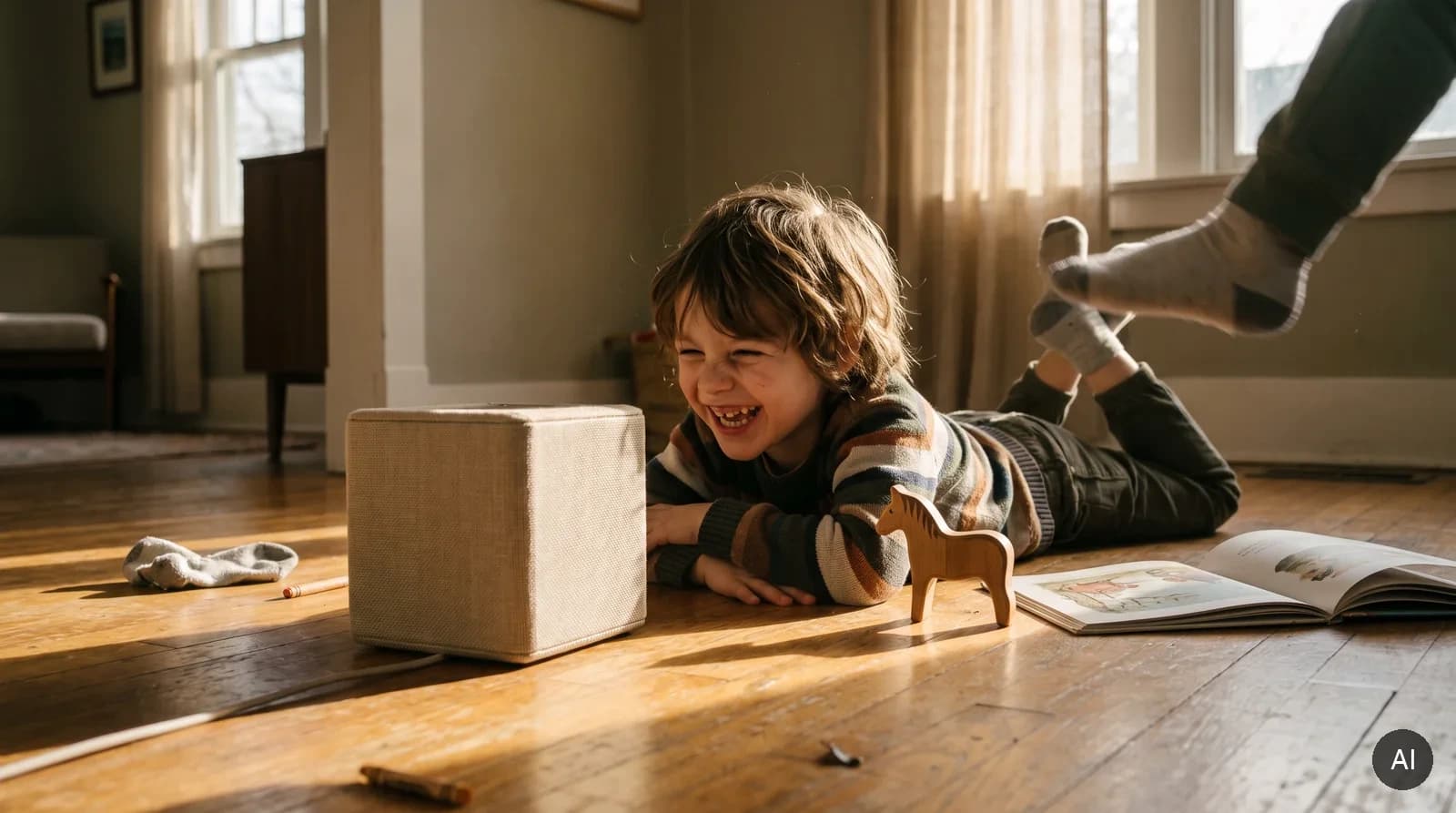
The child is lying on their stomach on the floorboards, chin in both hands, feet kicked up behind them, laughing out loud at something only they can hear. A sock lies nearby, a red crayon, a wooden horse. A voice comes out of the cube. For twelve minutes the child has been looking at nothing — and has been somewhere else entirely.
For parents this is the moment for a small pat on the back: at least it isn't a screen. And right after it comes the puzzlement. The child does not look relaxed. They look more focused than in front of the tablet, not less. Where does that attention go when there is nothing to look at?
The guidance says what to take away
Anyone looking for a number finds one quickly. Since 2023 there has been a medical guideline for it: eleven professional bodies, led by the German Society for Paediatrics and Adolescent Medicine, set out how much screen time is defensible at which age. The figures are tighter than most people expect.
| Age | Daily screen time outside school |
|---|---|
| under 3 years | none at all |
| 3 to 6 years | 30 minutes at most |
| 6 to 9 years | 30 to 45 minutes |
| 9 to 12 years | 45 to 60 minutes |
| 12 to 16 years | one to two hours |
But a guideline describes an upper limit, not an afternoon. It says what should go — not what moves into the same slot, or whether that is any better. At home that gap is usually filled by audio stories. Which puts the question from the opening more sharply: is listening really the easier exercise for a child?
Three formats and an MRI scanner
A team led by the paediatrician John Hutton at Cincinnati Children's Hospital did not ask that question but measured it. Preschoolers, just under five on average, were given the same five-minute story three times — once as audio alone, once with still illustrations, once as an animation. An MRI scanner recorded which brain networks worked together. Afterwards the children were tested on what had stuck.
The first result counts against listening. With audio alone the language network had to work hardest; adding pictures measurably reduced that strain. The researchers describe the audio-only version as the coldest of the three — the child has to build the whole scene alone, and that is demanding. The obvious conclusion is that it must therefore be worse.
The sentence that turns it around
Then comes the part that most summaries leave out. The effort did not cost comprehension. When tested, the children did just as well after the audio-only version as after the illustrated one. They did worse after the animation — the very format that had done the most work for them.
27 children
That is the real finding, and it inverts everyday logic. What looks like relief from the outside — moving pictures, everything already there — delivered the least. During the animation, the study found the weakest link between attention and language: the child was watching rather than following the story.
What the study does not support
Anyone concluding that audio stories beat picture books has not read the same study to the end. Hutton's recommendation for this age is explicitly different: the illustrated story came out best — still pictures plus a voice, because seeing, language and reflection worked together most evenly there. For a four-year-old, this measurement makes the read-aloud picture book the stronger form. Not the audio story.
Add what limits any single study: 27 children, one story, all formats in the same order, ages three to five. About eight-year-olds, whose language is long since secure, the measurement says nothing. It is a finding, not a law — and it still explains why the child on the floorboards looks the way they do.
Screen-free does not automatically mean together
There is a second figure, and it flatters less. The German media research group mpfs regularly asks parents of two- to five-year-olds what their children do with which medium — and above all, with whom. Television and video, it turns out, small children mostly watch together with their parents. With audio stories the picture flips.
54 %
So screen-free time has a blind spot nobody talks about much. It is often exactly the time when no one is sitting alongside — because that is the point of it, so the parents can do something else. Which is entirely legitimate. It just makes it something beside shared reading rather than a replacement for it.
The amount that is realistic
That leaves the question of how long such a block has to be. Here is a number from our own workshop: when parents order an audio story at fabeloo, they choose the length freely. Across more than eighty orders the average is eight and a half minutes. The shortest asked for five, the longest for twenty.
Which fits what the scanner showed. If listening is work, then it is not an activity for a whole afternoon but rather something a child does between two other things. The question «what do I fill two screen-free hours with» may already be the wrong one. Twelve minutes on the floorboards are not a stopgap. They are the format.
On the floorboards it is over now, the cube is quiet, the wooden horse lies tipped over beside it. What the child was laughing at is known to exactly one person in the room. You have to ask them, or you never find out.
Frequently asked questions
- From what age do audio stories make sense?
- Earlier than many think — length matters more than the number: Audio stories: the right age to start.
- Does an audio story count as screen time?
- No. The guideline covers screen media. It sets no upper limit for audio alone — which does not mean round-the-clock listening is harmless, but that there is less data on it.
- Is an audio story better than a picture book?
- For preschoolers, by the measurement cited here, no. The brain worked most evenly during the illustrated story with a voice. The audio story plays to its strength where no adult is reading along.
- Why do children fidget while listening?
- Because their hands are free — that is the difference from a screen. Drawing, building or lying around is not a sign of inattention, though the evidence here is thinner than for the format comparison.
- How long should an audio story for a preschooler be?
- Shorter than most people think. Parents who can choose freely order about eight minutes on average. One clear arc with a real ending carries better than an hour at a stretch.
Sources
- John S. Hutton, Jonathan Dudley, Tzipi Horowitz-Kraus, Tom DeWitt, Scott K. Holland: «Functional Connectivity of Attention, Visual, and Language Networks During Audio, Illustrated, and Animated Stories in Preschool-Age Children», Brain Connectivity 9(7), 2019, pp. 580–592 (via PubMed)
- miniKIM 2020, Medienpädagogischer Forschungsverbund Südwest (mpfs) with SWR
- S2k guideline «Prävention dysregulierten Bildschirmmediengebrauchs in Kindheit und Jugend», led by the German Society for Paediatrics and Adolescent Medicine, AWMF register 027-075, 2023
You might also like
3 Sept 2026·6 min read
The fortieth dragon
The same audio story for the fortieth time, and you cannot take it any more. Why children repeat, why it wears adults down — and what helps at the fridge.
Read more
1 Sept 2026·7 min read
The Finger Above the Button
Sleep aid or stimulant? What sleep research actually shows — and how to tell an evening-suitable story from a daytime one.
Read more